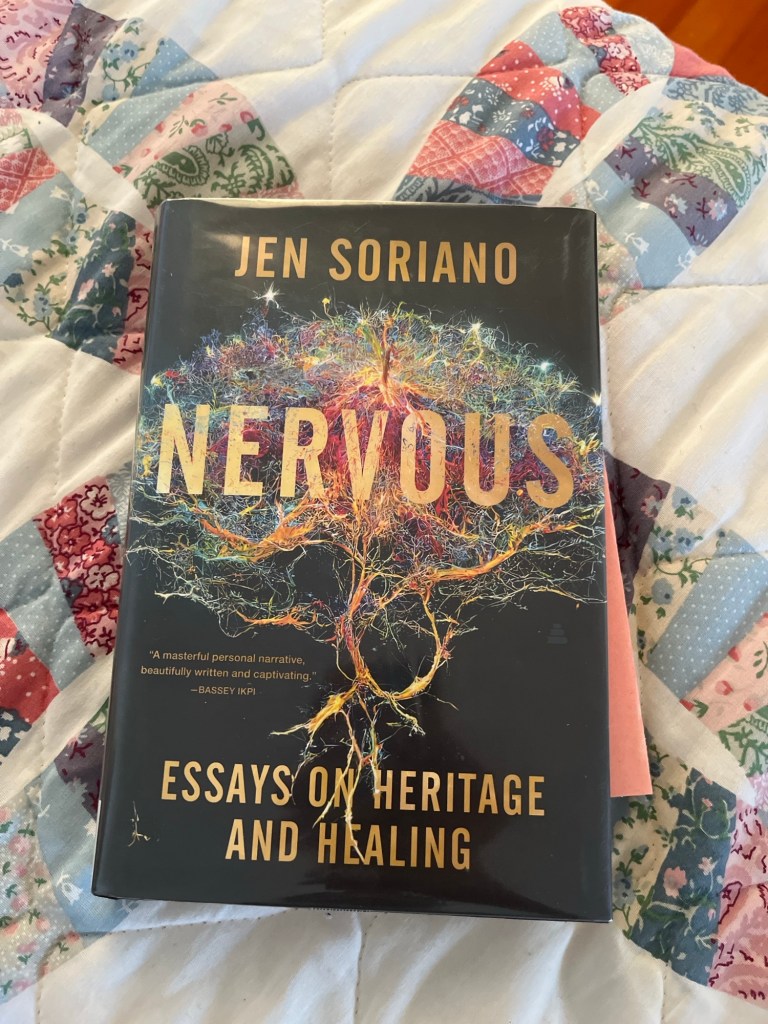
A friend recommended Jen Soriano’s book of essays called Nervous: essays on heritage and healing (2023, Amistad/HarperCollins), which is chock full of vivid vernacular. The history poetry in the middle of the book from pages 106-130 fleetingly describes the horrors of genocide that dot the Philippines archipelago across more than five centuries. It’s brutal to read how there’s (yet) another place on Earth where White Americans perpetrated battles that were a different locus of “kill the Indian, save the man” though there were plenty of villages, islands, and communities where the colonizers who barged in first from Spain then the United States then Japan did not focus on saving very many as they murdered, maimed, raped and plundered millions. They sought to eradicate and eliminate.
One facet of Soriano’s writing has been taking phrases and sentences that I convert into mad libs so I can play with memories and recall, phrases like:
- He was a ____ who used his ____ to ____ ______ to solve _____ _____. (28)
- What happened to my ______ system and how can I understand it? (32)
- [my father and I] “shared the perspective that” _____. (37)
- It is a snapshot of a childhood of _____ that affected my nervous system for life. (50)
- She cares for me like a _____. (62)
I’ll have to fill in these five. I would say that: She cared for me like a baker or a florist. Measured, patient, appreciative of how an oven transforms and grows the loaf that gets put inside as dough. As a florist, gentle, coaxing and attentive, pruning to guide so that I stretch up, but not coercing my growth, plenty of water sometimes with electrolytes or a few drops that alter the imbibed liquid.
On the other hand, Dad and I shared the perspectives that chemistry of a team and ethical conduct in a group was as important or more important than the end result, where the ends do not justify the means. Dad also repeated how life isn’t fair throughout my childhood.
In adulthood, I comprehend his sincerity that I couldn’t fathom when I was young. I judged that adage as some sort of callous indifference or crassness or hardened masculinity. But now, I recognize it was a way that Dad was letting me in on some of his hard and awful humankind is. That he was doing me a favor by not sugar-coating the ugliness of humans perpetrating violence and genocide and rape and incarceration and family separations and mass mutilations and state-sponsored rewards and subsidies for polluting and maiming. What Deborah Jackson Taffa describes in Whiskey Tender as:
A father’s job was to control the pace of the world’s wounding, to dole out the pain in slightly bigger doses over time so that his kids would learn not to break under pressure. (11)
For me, Dad started it off by uttering those three words: life isn’t fair.

